
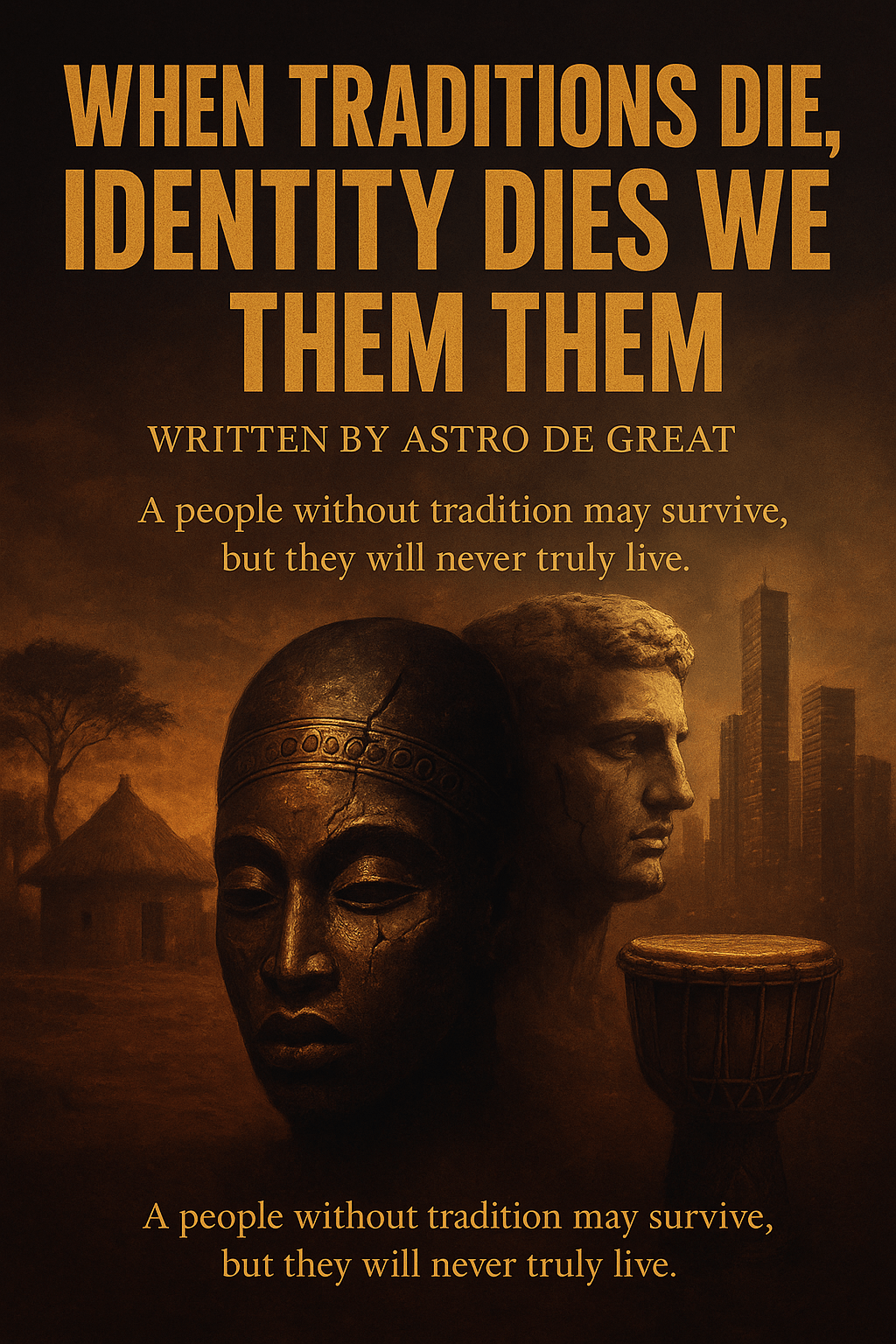
Tradition is more than a ritual; it is the invisible thread that ties people to their roots, a bridge between the living and those who walked before. When a society loses its traditions, it loses far more than customs it loses identity, memory, and the very compass that guides its steps into the future. It is like a man with no surname, wandering through life without a name to call his own.
Across history, traditions have been the silent guardians of identity. Ancient Africans told their stories through folktales, moonlight gatherings, masquerades, and ancestral rites. These weren’t just entertainment; they were living classrooms where the young were initiated into wisdom, respect, courage, and spiritual balance. The Igbo breaking of kola nut wasn’t just a casual gesture but a sacred recognition of unity and peace. Among the Yoruba, the talking drum wasn’t just music it was a language that carried emotions, warnings, and histories across villages. When these practices are abandoned, entire languages of the soul fall silent.
Colonialism struck hard at the heart of tradition, replacing centuries-old rituals with borrowed practices and foreign tongues. In the rush to embrace “modernity,” many communities began to see their own heritage as backward, primitive, or irrelevant. A people ashamed of their traditions are like children ashamed of their parents; they inherit wealth but despise the hands that built it. Slowly, songs were forgotten, names were changed, festivals were watered down, and sacred practices that once carried identity were abandoned. With every lost custom, a piece of the people vanished too.
The loss of tradition is not just cultural it is deeply psychological. A child raised without stories of who they are grows up chasing borrowed identities. They may wear the clothes of another people, speak their accents, even worship in borrowed patterns, but deep inside there is a hollow cry: Who am I? Nations that lose their traditions are easy to manipulate, because they no longer stand on their own foundation. Their history becomes scattered, their pride becomes fragile, and their future becomes uncertain.
Yet tradition is not merely about clinging to the past it is about carrying the torch forward. Just as an old tree sheds leaves but keeps its roots strong, traditions give us the power to adapt without losing ourselves. When Japanese youth wear kimonos during cultural festivals, when Native Americans pass on the art of storytelling, when Africans teach their children proverbs, they are not resisting progress they are reminding the world that true modernity is only meaningful when rooted in memory.
To lose traditions is to lose the heartbeat of identity. It is to trade the rhythm of your ancestors for silence. A people without tradition may still exist, but they do not truly live; they become shadows imitating others. The challenge of today is to rediscover those old paths not as relics for museums, but as living flames that can warm a new generation. For when we honor our traditions, we honor ourselves, and when we lose them, we lose the very definition of who we are.
Would you like me to expand this further into a storytelling style where I trace the journey of one family or community that lost its traditions and struggled to reclaim them so it feels more emotional and personal?
 Astro
Astro 