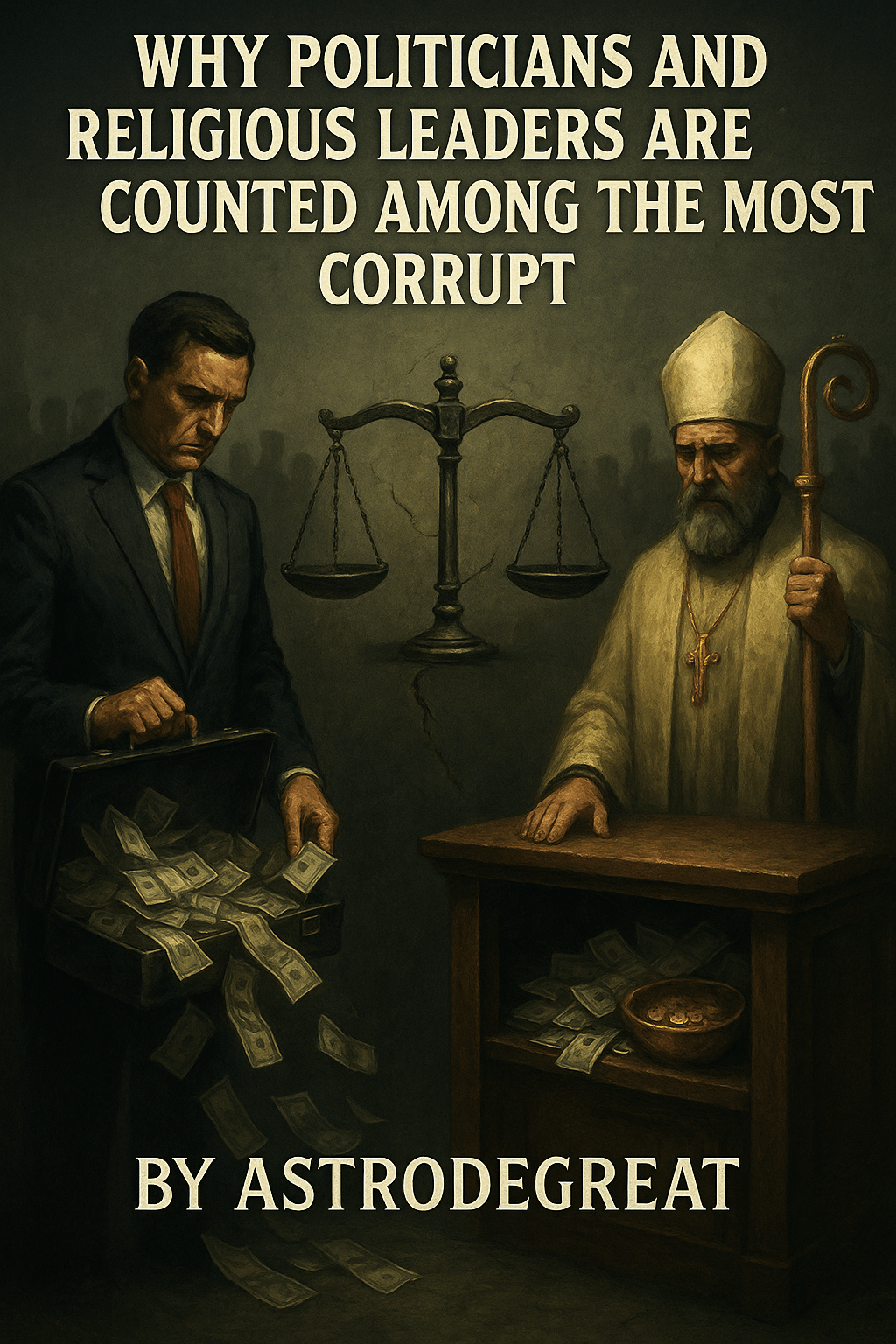
Corruption has become one of the most pressing global issues, and two groups consistently emerge in public discourse as the most corrupt: politicians and religious leaders. While this does not mean every individual in these roles is corrupt, these positions attract the most suspicion—and often, for good reasons.
This article breaks down the reasons behind this perception in a way that is engaging, truthful, and easy to understand.
🔹 1. They Hold Enormous Power—and Power Corrupts
The saying “power tends to corrupt, and absolute power corrupts absolutely” applies perfectly here.
- Politicians make laws, control national budgets, award contracts, and influence security agencies.
- Religious leaders control minds, shape beliefs, and command loyalty that even family members may not have.
When people have unchecked authority, they often start to act as though they are above the law or divine. Corruption becomes a side effect of their ego and influence.
🔹 2. They Handle Huge Resources with Minimal Oversight
One of the strongest temptations to corruption is access to money and resources—especially when no one is monitoring how it’s used.
- Politicians handle billions in national or state budgets, but many don’t report exactly how those funds are spent.
- Religious leaders receive tithes, offerings, donations, and sometimes foreign aid, with no financial transparency or external audits.
Without proper checks and balances, greed takes over, and resources meant for the public or congregation are diverted into private pockets.
🔹 3. They Enjoy Undeserved Trust
These two groups earn people’s trust by default:
- A politician says “I’ll build roads and provide jobs,” and people believe him—at least during elections.
- A religious leader says “God told me to collect this seed offering,” and no one questions it.
This automatic trust becomes a weapon. It gives them the freedom to manipulate emotions, lie, and exploit, all under the cover of “service” or “divine assignment.”
🔹 4. They Are Protected by Loyalty and Fear
People are often afraid to speak up against these figures:
- A critic of a corrupt politician may be arrested, harassed, or blacklisted.
- A follower who questions a religious leader may be shunned, labeled rebellious, or told they are under a “curse.”
This culture of silence makes it hard to challenge wrongdoing. Corruption thrives in silence, and these leaders often surround themselves with loyalists who benefit from their corrupt activities.
🔹 5. They Use Corruption Disguised as Righteousness
Corrupt people rarely come out plainly. Instead, they mask their theft with good language:
- A politician may loot funds through a fake contract, then call it “development.”
- A religious leader may sell fake miracles or collect funds with no accountability, calling it “faith seed” or “kingdom investment.”
Because these actions are cloaked in respected roles, people hesitate to call them out—fearing backlash or divine punishment.
🔹 6. The Damage They Cause Is Deep and Widespread
Corruption in government or religion doesn’t just affect one person—it affects generations:
- A corrupt politician may embezzle funds meant for education, healthcare, or infrastructure, leaving a whole nation in poverty.
- A corrupt religious leader may bankrupt families, mislead congregants, and destroy people’s emotional and spiritual wellbeing.
That’s why their corruption is often louder and more destructive than others. It’s not just a private sin—it becomes a public disaster.
🔹 7. They Are Rarely Punished
Perhaps the most painful reality is that many corrupt politicians and religious leaders go unpunished. In fact, some:
- Get re-elected or promoted.
- Build bigger churches or political empires.
- Gain more followers and admiration.
When people see that corruption brings power, fame, and money without consequence, the cycle continues. Worse still, younger people may begin to aspire to corruption as a path to success.
🔚 Conclusion: Not All Are Corrupt, But the Impact of the Few Is Great
It is important to say clearly: not every politician or religious leader is corrupt. There are honest public servants and sincere men and women of faith.
However, the structure of unchecked power, lack of transparency, manipulation of trust, and the scale of damage when things go wrong—make these two groups stand out in the public eye when it comes to corruption.
To fix this, we need:
- Stronger accountability systems
- Civic education
- Spiritual maturity
- And most importantly, people brave enough to ask hard questions without fear
✅ Corruption is not just about money—it’s about broken trust. And when trust is broken in leadership, society begins to collapse.
Please like and subscribe for more content like this.
 Astro
Astro 
These is deep
LikeLiked by 1 person