
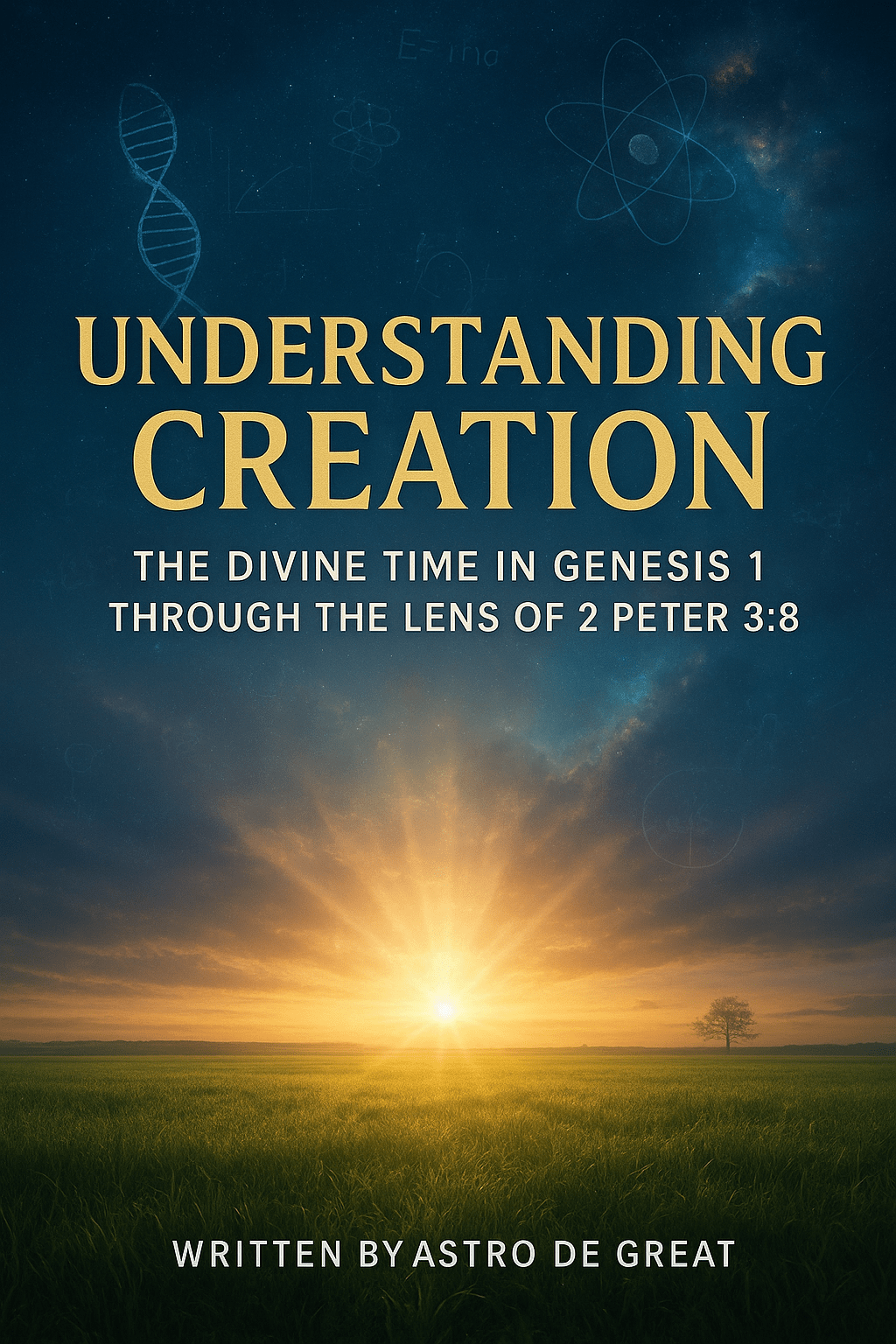
The Divine Time in Genesis 1 Through the Lens of 2 Peter 3:8
Written by ASTRO DE GREAT
Introduction
For centuries, scholars, theologians, and scientists have debated the true meaning of the seven days of creation in the Book of Genesis. Were those days literal 24-hour periods, or do they represent something deeper something beyond human time itself?
To understand this, we look at 2 Peter 3:8, where the Apostle Peter writes:
“But, beloved, be not ignorant of this one thing, that one day is with the Lord as a thousand years, and a thousand years as one day.”
This single verse opens a window into the mystery of creation and helps us see the relationship between divine time and human time. When we read Genesis 1 through this divine lens, we begin to realize that what God called “a day” might not be the same as our human 24-hour cycle.
The Concept of Divine Time
Time is one of the most misunderstood realities of creation. Science defines time as a dimension a measurable period in which events occur in sequence. But before the universe existed, time did not exist as we understand it today.
Albert Einstein’s theory of relativity shows that time is relative to speed and gravity. This means that time moves differently depending on your position in space and the gravitational field around you. For example, a clock in space ticks faster than one on Earth because of gravity’s effect.
Now, if time can change within the universe, imagine how it behaves in the dimension of God, who exists outside of space, matter, and energy. For God, time is not linear; it doesn’t move from past to present to future. To Him, everything exists at once past, present, and future are eternally before Him.
So, when Genesis 1:1 says, “In the beginning, God created the heaven and the earth,” it doesn’t refer to the start of time for God, but to the beginning of time for creation itself. It was the moment eternity stepped into time.
The Science of “Days” in Genesis
In the original Hebrew text of Genesis, the word translated as “day” is “Yom.” This word does not always mean a literal 24-hour period; it can also mean a season, an era, or an age depending on context.
For instance, in Genesis 2:4, the entire creation week is summarized as “the day that the Lord God made the earth and the heavens.” This shows that “day” can represent a much longer span of time perhaps thousands or even millions of years.
From a scientific viewpoint, this interpretation aligns beautifully with the stages of cosmic and biological evolution. The universe did not appear in six human days; it unfolded gradually over immense periods of time through divine order and purpose.
On the first day, God said, “Let there be light.” Science tells us this corresponds to the Big Bang the explosion of light and energy that birthed the universe and separated light from darkness.
On the second day, God separated the waters above from the waters below, forming the atmosphere. This can be understood as the Earth’s early development, when vapor and gases condensed to create the sky and oceans.
On the third day, land appeared and vegetation began to grow. This matches the geological stabilization of continents and the first appearance of plant life on Earth.
On the fourth day, God made the sun, moon, and stars visible a stage representing the organization of our solar system and the clearing of the atmosphere so celestial lights could shine clearly on Earth.
On the fifth day, God created marine and aerial life fish and birds symbolizing the flourishing of aquatic and flying creatures after environmental conditions became stable.
On the sixth day, animals and humans were formed the era of advanced life forms and the awakening of human consciousness. Humanity became aware of self and spirit, bearing the image of God.
Finally, on the seventh day, God rested. This was not rest from tiredness but a moment of divine completion and equilibrium. The universe reached balance; the process of creation was fulfilled, and divine order was established.
When viewed through the insight of 2 Peter 3:8, each of these days could represent thousands or even millions of years in divine measurement. God’s “day” does not tick by seconds or hours but unfolds as epochs of divine manifestation.
The Harmony Between Faith and Science
Contrary to popular opinion, science and scripture are not enemies. They are two languages describing the same truth one in physical terms and the other in spiritual terms.
Science explains how creation unfolded.
Scripture explains why it unfolded.
When Genesis says, “Let there be light,” it describes the same reality that science calls the Big Bang a divine command translated into a physical explosion of light and energy.
When Peter said, “One day is as a thousand years to the Lord,” he was not giving a formula for time but revealing a truth: God operates beyond time. What takes humanity millennia to see may be a single moment in the eyes of the Eternal One.
Creation as a Process, Not an Instant Event
Creation is both instant and progressive. In the spiritual realm, God’s Word instantly brought everything into being yet in the physical realm, that Word unfolded gradually.
This dual nature of creation is seen even today. When God speaks a promise, it is fulfilled instantly in the spirit but may take time to manifest on Earth. The same pattern applies to the creation story.
Science agrees with this principle. Earth did not become livable overnight. It took billions of years for the planet’s temperature, oxygen level, and atmosphere to balance a gradual but intentional process guided by divine intelligence.
Thus, Genesis 1 is not a contradiction of science but a divine summary of what science later discovered in detail. The difference lies not in truth, but in perspective.
Theological Insight
Genesis 1:1 begins, “In the beginning, God created the heaven and the earth.”
John 1:1 mirrors it, saying, “In the beginning was the Word, and the Word was with God, and the Word was God.”
This means that “the Beginning” is not merely a point in time but a person Christ Himself. Christ is both the Beginning and the Architect of creation. Through Him, eternity entered time, and the invisible became visible.
When Peter speaks of God’s thousand-year days, he is describing the patience and eternity of God’s plan, where divine will unfolds step by step until perfection is revealed.
Conclusion
2 Peter 3:8 gives us a key to understanding Genesis 1 in a way that harmonizes both faith and science. It shows that:
- God’s time is not measured in human terms.
- The “days” of creation represent divine phases or ages, not literal 24-hour cycles.
- Science and Scripture describe the same creation from different angles one physical, one spiritual.
- Creation was both instantaneous in God’s command and progressive in its manifestation.
When read with this awareness, Genesis is no longer a story in conflict with science but a revelation of how eternity expressed itself in time.
It teaches that creation is not simply the work of time it is the manifestation of eternity.
“The universe is not just the work of time; it is the revelation of eternity.”
— Astro De Great
PLEASE LIKE, SHARE AND FOLLOW US FOR MORE CONTENT LIKE THIS
 Astro
Astro 