
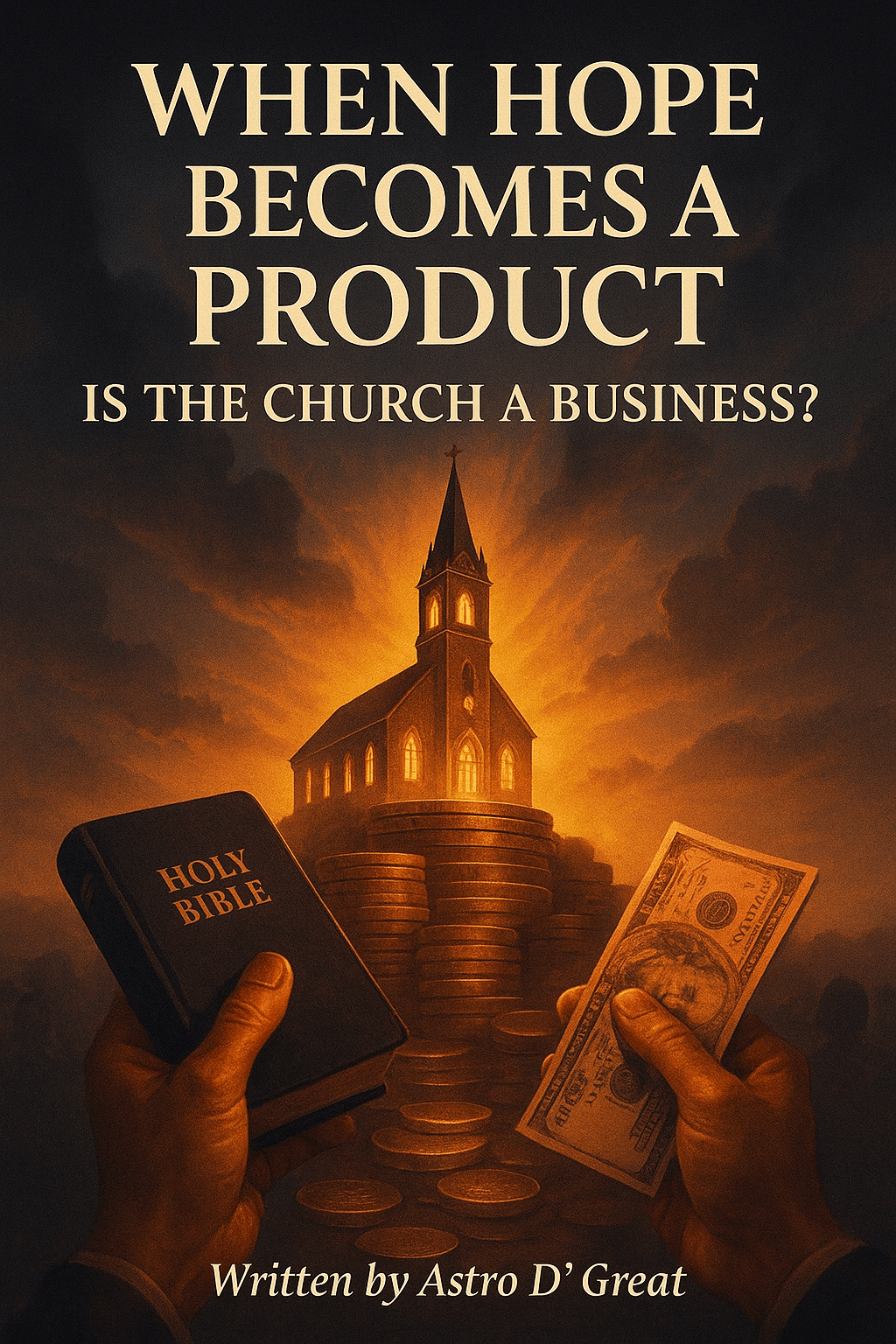
By Astro D’ Great
Let’s be honest for a moment.
If I tell you the church has become a business, don’t rush to argue pause, think deeply. Look around you; the signs are everywhere. What we call “ministry” today often mirrors the structure, system, and strategy of a business enterprise. And before you dismiss that as blasphemy, let’s break it down logically.
What Is a Business, Really?
A business is any organized system of transactions where goods or services are exchanged for a price usually in currency. Someone produces something, someone else consumes it, and money flows in between. That’s the cycle of commerce.
Now, what if I tell you that, in today’s world, the church operates in a similar cycle only that the goods are not shoes, phones, or clothes, but hope, faith, and miracles.
The Church’s Product: Hope
Hope is the most powerful invisible commodity in human history. It has built civilizations, driven wars, and healed broken souls. Without hope, humanity collapses. And the church knows this truth too well.
Every sermon, every song, every testimony, every declaration from the pulpit is designed to supply one thing hope. Hope that tomorrow will be better. Hope that your sickness will be healed. Hope that your business will grow. Hope that your tears will end.
That’s the product, and it’s a product people are willing to “pay” for not because it’s fake, but because it feeds the soul.
The Transaction: Faith and Currency
In business, customers pay for goods.
In the church, believers give offerings, tithes, seeds, and sacrifices.
The difference? In one, you pay for tangible goods. In the other, you pay in faith for intangible expectations. But make no mistake it’s still an exchange. You give, expecting a return blessing, breakthrough, favor, or healing.
That’s the transaction.
And just like any business, the church needs to sustain itself lights must stay on, the instruments must sound sweet, the rent must be paid, the media department must function, and the pastor’s life must be maintained.
The Expansion Strategy
Every business aims to grow to expand its reach, gain new markets, and build loyal customers. The church does the same, only that the market is souls and the product is salvation packaged with hope.
Evangelism becomes marketing.
Crusades become brand campaigns.
Tithes and offerings become the financial fuel for expansion.
Social media becomes the new marketplace of faith.
If you see it from this lens, the structure looks almost identical.
But Here’s the Difference That Matters
The goal of a true business is profit.
The goal of a true church should be transformation.
The danger begins when the focus shifts from winning souls to winning income, from feeding the flock to feeding the system. When pastors become CEOs, pulpits become stages, and members become customers, the spiritual core dies slowly replaced by branding, competition, and showmanship.
Yet, not every church is guilty. Many still carry the true burden of Christ, serving people with sincerity, using resources for impact, not luxury.
So, Is the Church a Business?
Yes and no.
Yes, because it operates on principles of exchange, organization, and sustainability.
No, because its original foundation was never meant for profit but for purpose.
The church becomes a business when the message becomes a means to manipulate emotions for financial gain.
But it remains a divine institution when it uses the same system of giving and organization to build lives and transform society.
The Final Thought
If you walk into a church and you feel like a customer rather than a family member, then you’re in a marketplace of religion, not a house of God.
If the altar becomes a platform for price tags instead of prayer, it’s no longer ministry it’s marketing.
But if you find a place that gives hope, truth, and direction without enslaving your faith to money, hold on to it. That’s where God still dwells.
Because hope was never meant to be sold it was meant to be shared.
 Astro
Astro 