
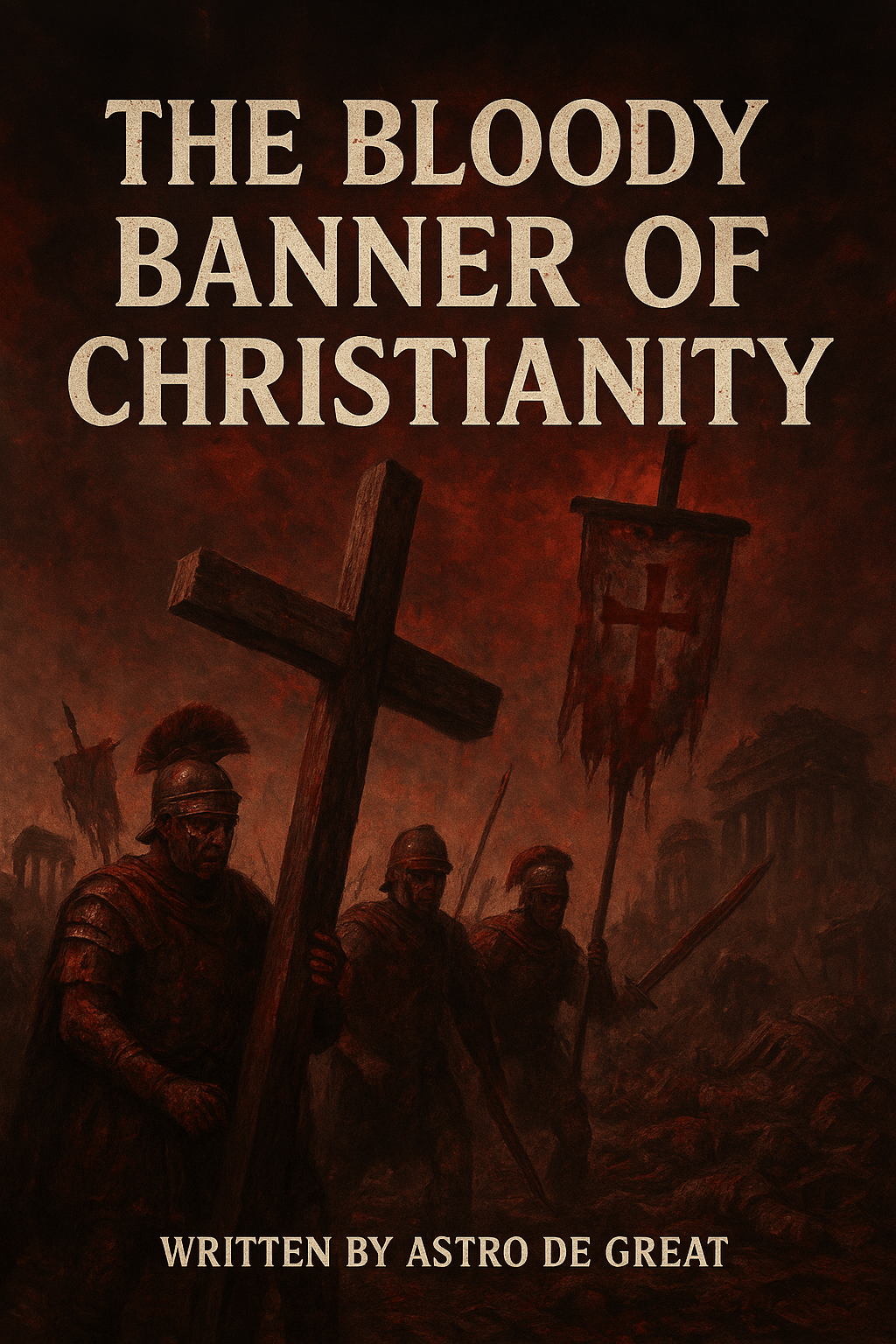
Christianity, at its core, is a faith of love, forgiveness, and reconciliation. The message of Jesus Christ was clear: “Love your neighbor as yourself” and “Blessed are the peacemakers.” Yet, when this sacred faith was carried through human hands across history, it often became entangled with power, conquest, and cultural suppression. The banner that should have symbolized light and healing sometimes inflicted wounds that scarred societies and injured cultures.
This tension between the message of Christ and the methods of men is one of history’s greatest paradoxes.
The Roman Empire and the Weaponizing of Faith
When Emperor Constantine legalized Christianity in the early 4th century, the faith that once thrived underground became an instrument of the state. Christianity gained political power, but at a cost. The same empire that once persecuted Christians turned Christianity into a tool of unification and control. Pagan practices were outlawed, temples destroyed, and entire cultural identities suppressed in the name of Christianization. The cross became not only a symbol of salvation but also a weapon of assimilation.
The Crusades: Holy War or Holy Injury?
From the 11th to the 13th century, the Crusades marked one of the darkest episodes in Christian history. Declared as wars to reclaim the Holy Land, they led to rivers of blood flowing in Jerusalem, Antioch, and Constantinople.
- In 1099, during the First Crusade, crusaders massacred both Muslims and Jews in Jerusalem, leaving behind a trail of corpses.
- Instead of spreading the love of Christ, these wars reinforced hostility between Christians and Muslims, a wound still visible in interfaith relations today.
Here, Christianity’s banner was stained with conquest rather than compassion.
Colonialism: The Bible and the Sword
Perhaps no period illustrates the “inhuman carrying” of Christianity more vividly than the colonial era. European powers, in their quest for land and resources, often marched with two banners: the cross and the crown. Missionaries, explorers, and armies traveled together, presenting Christianity as a companion of empire.
- In the Americas, indigenous peoples were forced to abandon their traditions. Entire civilizations, such as the Aztecs and Incas, saw their temples razed and their languages suppressed.
- In Africa, colonial missionaries often condemned local spiritual practices as “pagan” or “devilish.” While some brought education and healthcare, many also served as cultural gatekeepers, aligning with colonial authorities to dismantle centuries-old traditions.
- In Asia, particularly in India and China, Christianity was tied to imperial dominance, seen not as a faith of freedom but as a tool of foreign interference.
For many cultures, the arrival of Christianity felt less like salvation and more like invasion.
Slavery and the Distorted Gospel
Another chapter where Christianity’s banner injured humanity was in the transatlantic slave trade. European and American slaveholders used distorted interpretations of the Bible to justify enslaving millions of Africans. Scriptures were selectively quoted to enforce obedience, while entire passages about freedom and dignity were ignored.
Though many genuine Christian voices, such as William Wilberforce and the Quakers, fought fiercely for abolition, the damage was already done: Christianity had been presented to enslaved peoples not as liberation, but as submission.
The Irony of the Gospel Message
What is most tragic is the contrast. The very faith that teaches compassion was too often weaponized for domination. But it would be unfair to say Christianity itself is guilty. Rather, it was the hands that carried it governments, empires, and men hungry for power that turned a message of love into a banner of conquest.
The irony is that while cultures were injured under the shadow of forced conversion, Christianity also survived in its purest form among the oppressed. African slaves in America reshaped Christianity into a faith of liberation, birthing spirituals and movements of hope. Indigenous communities reinterpreted the gospel through their traditions, keeping their cultural essence alive.
Healing the Historical Wounds
Today, Christians are called to reckon with this history. A respectful acknowledgment of past wrongs is not an attack on faith but an act of honesty. Understanding that the banner of Christianity was sometimes used in inhuman ways allows space for healing, dialogue, and reconciliation.
The true spirit of Christ was never conquest, never cultural erasure, never oppression. It was and still is love, humility, and the restoration of dignity. To carry Christianity rightly today means ensuring that it heals rather than harms, uplifts rather than suppresses, and embraces rather than conquers.
✨ Conclusion
History teaches us a sobering truth: when men carried the banner of Christianity for their own gain, cultures bled. But when carried in the spirit of Christ, the banner becomes a light to the nations. The challenge for our time is to separate the eternal message from the mistakes of history to ensure that Christianity is no longer an injury to cultures but a blessing to humanity.
Would you like me to expand this into a longer, episodic form (like a mini historical series with multiple “episodes”), or sho
 Astro
Astro 