From Sacred Symbol to Scientific Origin A Journey into the Birth of Life
By ASTRO D’ GREAT
Have you ever looked up at the stars and wondered: Where did life begin?
What is the origin of everything not just humans, but bacteria, trees, animals, even thoughts?
There is a mystical pattern known as the Seed of Life a geometric flower of overlapping circles often seen in ancient architecture, temples, and spiritual scrolls. But beyond its sacred meaning, the “Seed of Life” also holds deep biological and scientific truth.
Let’s take a journey a fascinating one from mysticism to molecules, from divine geometry to DNA.
What is the Seed of Life?
The Seed of Life is a spiritual symbol, made of seven overlapping circles. It has been found in ancient Egyptian temples, Christian churches, and even Buddhist mandalas. It represents creation, life, and conscious design. It’s often said to illustrate the seven days of creation in Genesis, or the steps through which the universe unfolded.
But what if this symbol isn’t just mystical?
What if it’s also a clue — to the natural patterns through which life itself emerged?
The Seed of Life – Scientifically Speaking
In biology, the “seed of life” represents the moment when non-living chemicals gave rise to living cells the origin of life itself.
This is not mythology. It’s a well-studied phenomenon called abiogenesis the process where life emerged from lifeless matter.
Where Did It Come From? (A Scientific Breakdown)
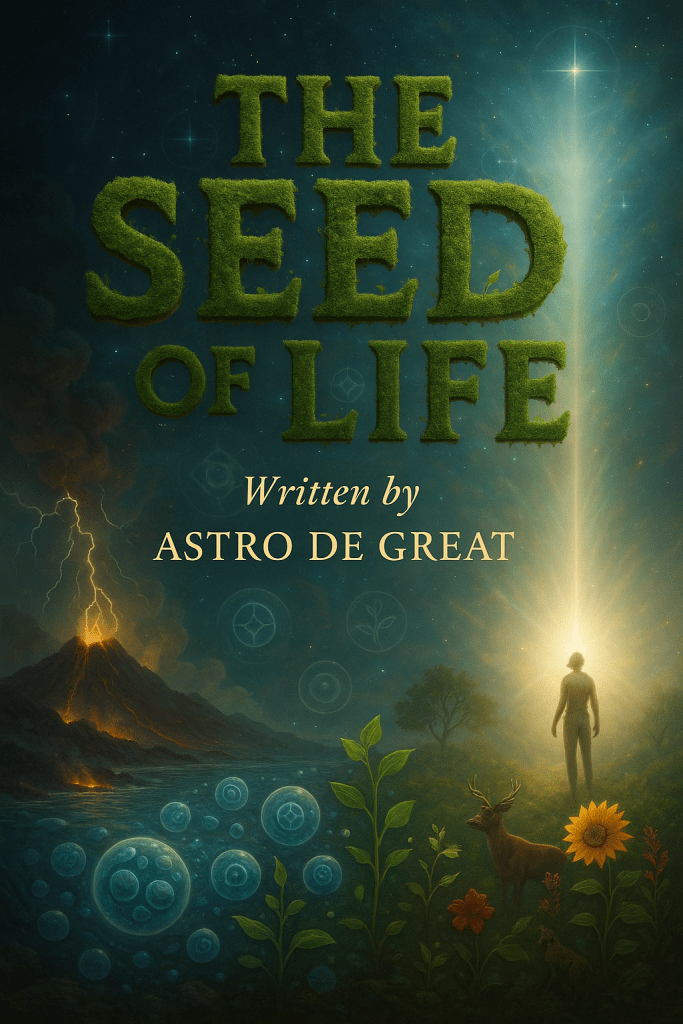
Billions of years ago before dinosaurs, before trees, even before oxygen Earth was a hot, volcanic planet covered with oceans. But in those turbulent waters, something miraculous happened:
Life was born.
Not from magic. But from a process.
The Process: How Life Began on Earth
Let’s break it down in a way anyone from scientist to student can understand:
Step 1: The Chemical Soup
Early Earth was full of basic chemicals: hydrogen, methane, ammonia, and water. When lightning struck, or volcanoes erupted, these elements reacted.
Scientists like Miller and Urey (1953) recreated this in a lab and produced amino acids, the building blocks of proteins. That’s like mixing flour and water and ending up with dough!
Nature was cooking life.
Step 2: Formation of Simple Molecules
Over time, amino acids linked to form proteins. Other molecules like RNA (a cousin of DNA) formed, too. RNA could copy itself a vital step for life.
These tiny molecules gathered inside bubbles of fat (called lipid membranes) the first protocells.
These weren’t alive yet, but they were on the edge of life.
Step 3: The First Living Cell
Eventually, some protocells developed:
- A membrane (to hold things together)
- Metabolism (to use energy)
- Replication (to reproduce)
This was it: Life.
The first true cell microscopic, simple, yet powerful floating in Earth’s oceans around 3.5 to 4 billion years ago.
From Simple Cells to Human Beings
That single cell was the seed.
Now let’s trace how that seed grew into us.
1. Evolution Begins
The first cells mutated, copied themselves, and slowly changed. Over time, some learned to use sunlight (photosynthesis) and began producing oxygen.
This changed Earth’s atmosphere completely making it possible for more complex life to evolve.
2. From One Cell to Many
Some cells began working together, becoming multicellular. This allowed for division of labor some cells became muscles, others brains, others skin.
Boom! Now we’re talking animals, plants, fungi.
3. The Rise of Complex Creatures
About 540 million years ago, the Cambrian Explosion occurred. Life diversified rapidly.
- Fish appeared.
- Then amphibians.
- Then reptiles and birds.
- Then mammals.
And finally… humans.
From apes to early humans (hominids) to modern Homo sapiens over millions of years shaped by natural selection, environment, and adaptation.
What Makes This Convincing?
Because it’s not random. It follows patterns like the circles in the Seed of Life.
- Life began with simplicity.
- Life evolved through trial and error.
- Life progressed through repetition and design not from a machine, but from nature’s quiet intelligence.
It is beautiful, even poetic.
Why Should You Care?
Because you are part of that story.
Every breath you take, every heartbeat, every thought all of it is rooted in a process that began with the first living cell, billions of years ago.
It humbles us.
It connects us.
It gives meaning to our existence.
Full Circle: Science Meets Spirit
And now, look again at the Seed of Life symbol.
Do you see it differently?
It’s no longer just a geometric pattern.
It’s a map of reality of how the universe expresses itself.
From atoms to cells.
From circles to civilizations.
From chaos to consciousness.
In Conclusion:
🌱 So the next time you wonder where we came from, remember:
You are the fruit of a seed — ancient, sacred, and alive. 🌍
 Astro
Astro 