
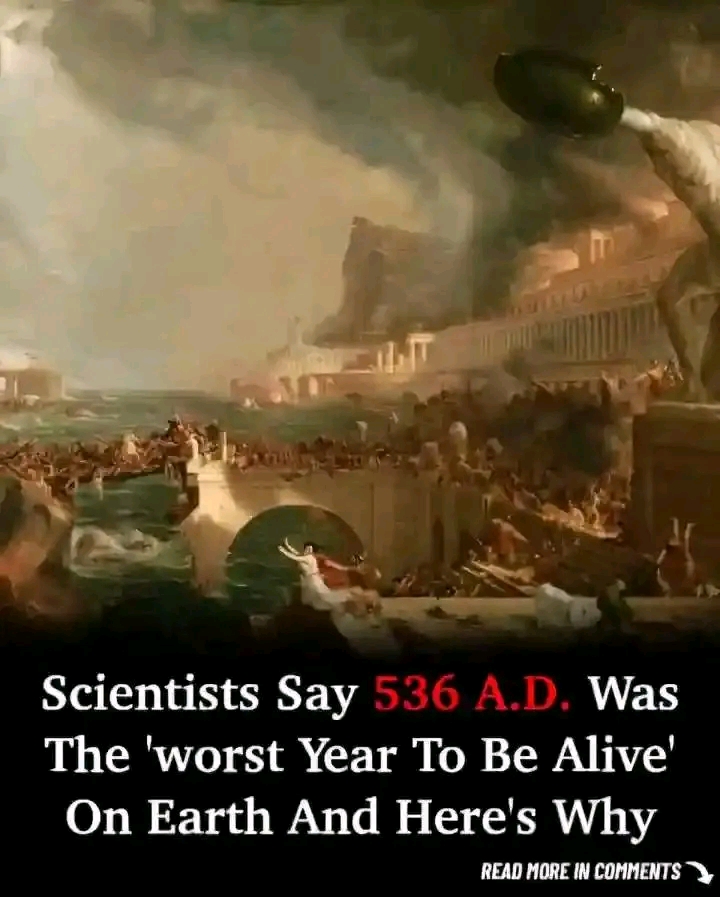
Throughout history, certain years have stood out for their unparalleled suffering, devastation, and societal collapse. Among these, the year 536 A.D. has been dubbed by some historians and scientists as the “worst year to be alive.” But what made this year so uniquely catastrophic?
A Dark Veil Over the Earth
The events of 536 A.D. began with a mysterious and catastrophic climatic anomaly. A dense, impenetrable fog descended over much of the Northern Hemisphere, plunging large swathes of the world into darkness for 18 months. According to historical records, the sun was so dim that it cast no shadows at midday, and temperatures dropped drastically, leading to one of the coldest decades in the last 2,000 years.
This climatic event was caused by a massive volcanic eruption, likely in Iceland, which spewed vast amounts of ash and sulfur into the atmosphere. The resultant volcanic winter drastically reduced global temperatures, leading to widespread crop failures and famine.
Widespread Famine and Plague
The effects of the volcanic eruption were felt far and wide. In the Byzantine Empire, chronicler Procopius wrote that the sun “gave forth its light without brightness, like the moon, during this whole year,” leading to a year without summer. Crops failed across Europe, the Middle East, and Asia, leading to widespread famine. With food scarce, many communities descended into chaos, and starvation became rampant.
But the suffering didn’t end there. The weakened and malnourished populations became vulnerable to disease, and in 541 A.D., just a few years after the volcanic winter began, the Justinianic Plague struck. This early outbreak of bubonic plague spread rapidly through the Mediterranean, killing an estimated one-third to half of the population in some regions.
Economic and Social Collapse
The combined effects of climatic disaster, famine, and plague led to significant economic and social upheaval. The Byzantine Empire, which was already embroiled in wars and political strife, faced further destabilization. Trade routes were disrupted, agricultural production plummeted, and entire communities were decimated. The collapse in food supply and the spread of disease led to a sharp decline in population, which in turn caused labor shortages and economic decline.
In Europe, the societal impact was profound. The combination of famine, disease, and political instability marked the beginning of what would later be known as the Early Middle Ages, a period characterized by a decline in urban life, loss of knowledge, and general regression in cultural and economic development.
The Legacy of 536 A.D.
The year 536 A.D. serves as a stark reminder of how vulnerable human societies are to environmental and climatic changes. The catastrophic events of that year were not caused by human actions but by natural forces, yet they had a profound impact on the course of history.
Modern scientists continue to study the events of 536 A.D. to better understand the interplay between climate, environment, and society. The lessons learned from this period are increasingly relevant today as we face our own environmental challenges, including climate change and pandemics. The resilience of human societies is remarkable, but the events of 536 A.D. show that even the most powerful civilizations can be brought to the brink by forces beyond their control.
As we reflect on the “worst year to be alive,” we are reminded of the fragility of our world and the importance of preparedness, adaptability, and resilience in the face of global challenges.
 Astro
Astro 