Introduction
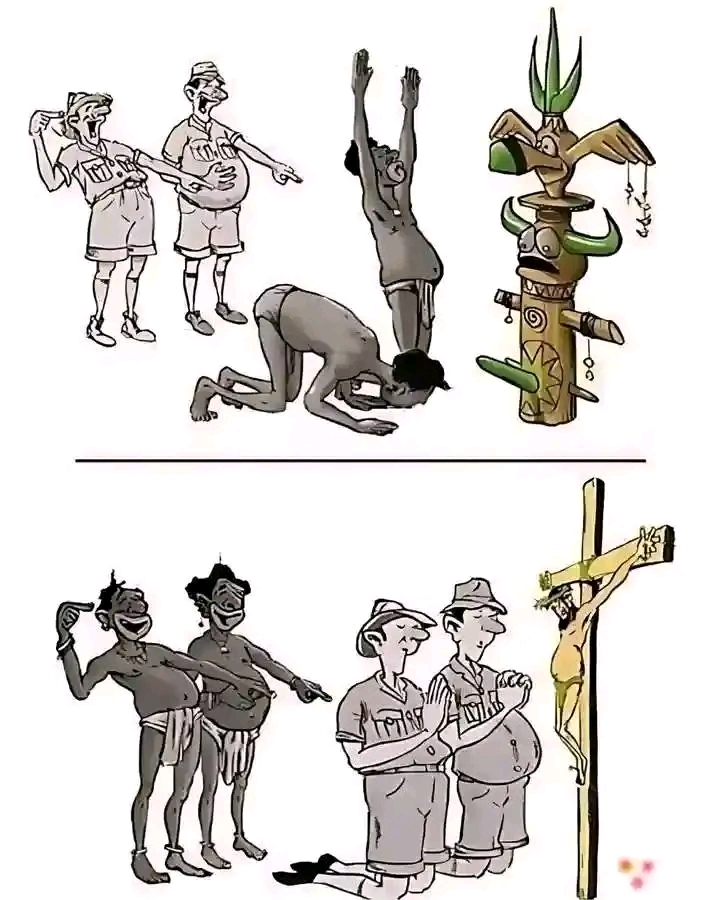
Art has long been a medium for expressing complex ideas, emotions, and critiques on society. The image provided showcases two contrasting scenes that provide a striking commentary on the perceptions and practices surrounding religion, culture, and spirituality. By juxtaposing two sets of individuals and their religious expressions, the artist invites viewers to reflect on the inherent biases and judgments that arise when different cultural practices are observed.
The Dichotomy of Worship
In the top part of the image, we see what appear to be tribal figures engaging in a form of traditional worship, possibly praying to a totem or an idol. The scene is characterized by a deep sense of reverence and devotion. The individuals are depicted in various postures of prayer and worship, with one figure bowing deeply and another raising hands in supplication. The totem, adorned with symbolic elements, stands tall as the focal point of their religious activity.
In contrast, the lower part of the image presents two Western-looking men kneeling in prayer before a crucifix, which is a universally recognized symbol of Christianity. The two men, in contrast to the figures above, are depicted with solemn expressions, engaging in what is presumably a sincere act of religious devotion. The crucifixion scene, much like the totem, is a significant religious symbol, yet the expressions of worship are markedly different.
The Role of Satire and Critique
One of the most powerful elements of this artwork is its use of satire. The expressions of the characters in both scenes tell a story that transcends the mere act of worship. The tribal figures are depicted as engaging in their rituals without any awareness of outside scrutiny, while the Western men are shown with somewhat exaggeratedly pious expressions.
The critique lies in the irony that both groups are, in essence, doing the same thing—expressing their beliefs and devotion to what they hold sacred. However, the satirical twist emerges when one considers how these groups might view each other. The tribal figures in the top image could be seen by some as “primitive” or “pagan” by those who adhere to Western religious norms, while the lower image could be interpreted as a subtle jab at the sometimes performative nature of religious devotion in Western contexts.
The Impact of Cultural Bias
This artwork also forces the viewer to confront their own biases. It questions how we perceive “otherness” in religious practices. The juxtaposition serves as a reminder that all cultures have their forms of spiritual expression, which may appear strange or alien to those who are not part of that culture. By placing these two scenes side by side, the artist challenges the viewer to consider why one form of worship might be deemed acceptable and another dismissed or ridiculed.
Conclusion
In essence, this image serves as a profound commentary on the universality of religious expression and the often arbitrary nature of cultural judgment. It invites reflection on the way different cultures are perceived in relation to their spiritual practices and calls into question the validity of those perceptions. Through the use of contrast and satire, the artist has created a piece that not only critiques societal norms but also encourages a broader understanding and acceptance of diverse religious expressions. This image is a visual reminder that at the core of all religious practice is a shared human experience of seeking connection with something greater than ourselves, regardless of the form it takes.
 Astro
Astro 