
Introduction
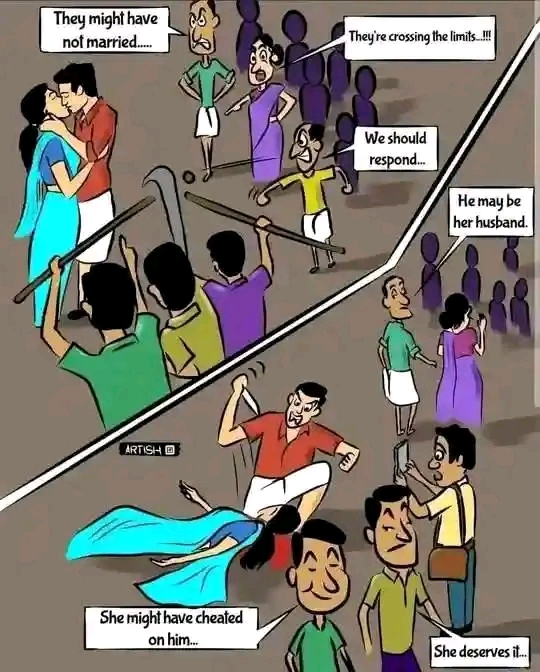
In the age of social media and constant connectivity, public scrutiny and judgment have reached unprecedented levels. A recent cartoon vividly illustrates the hypocrisy and double standards prevalent in our society, particularly regarding issues of morality and violence. This piece serves as a critical reflection on how societal attitudes towards public displays of affection and domestic violence reveal deep-seated biases.
The Cartoon Breakdown
The cartoon is split into two distinct scenarios.
- Public Affection and Immediate Judgment:
- Scene: A couple is shown kissing in public.
- Public Reaction: A group of onlookers, including individuals wielding tools like sticks, immediately judge the couple. Their comments include:
- “They might have not married…”
- “They’re crossing the limits…!”
- “We should respond…”
- Domestic Violence and Societal Justification:
- Scene: In a contrasting scenario, a man is seen beating a woman.
- Public Reaction: This time, the onlookers offer excuses and justifications for the man’s actions:
- “He may be her husband.”
- “She might have cheated on him…”
- “She deserves it…”
Analyzing the Double Standards
The cartoon sheds light on several disturbing aspects of societal attitudes:
- Tolerance for Violence:
- The immediate justification for domestic violence based on marital status or presumed infidelity is alarming. It reflects a dangerous acceptance of violence within certain contexts, revealing deep-seated patriarchal norms that prioritize a man’s authority and control over a woman’s autonomy.
- Public Displays of Affection (PDA) as a Moral Breach:
- The harsh reaction to a couple kissing in public highlights a prevalent conservative mindset that views expressions of love and affection as morally offensive. This reaction often stems from rigid cultural norms that dictate appropriate behavior, especially in public spaces.
- Victim Blaming:
- The cartoon also exposes the pervasive issue of victim blaming. The woman’s suffering is rationalized through assumptions about her character, shifting the blame from the perpetrator to the victim. This narrative perpetuates a cycle of violence and inhibits support for victims.
Conclusion
This cartoon serves as a powerful commentary on societal hypocrisy. It challenges us to reflect on our own biases and the ways in which we may unconsciously uphold double standards. As a society, it is crucial to advocate for consistent principles of justice and empathy, ensuring that acts of violence are condemned irrespective of context, and that expressions of love and affection are not met with undue hostility.
By addressing these issues openly and honestly, we can begin to foster a culture that prioritizes respect, understanding, and genuine concern for the well-being of all individuals.
 Astro
Astro 