
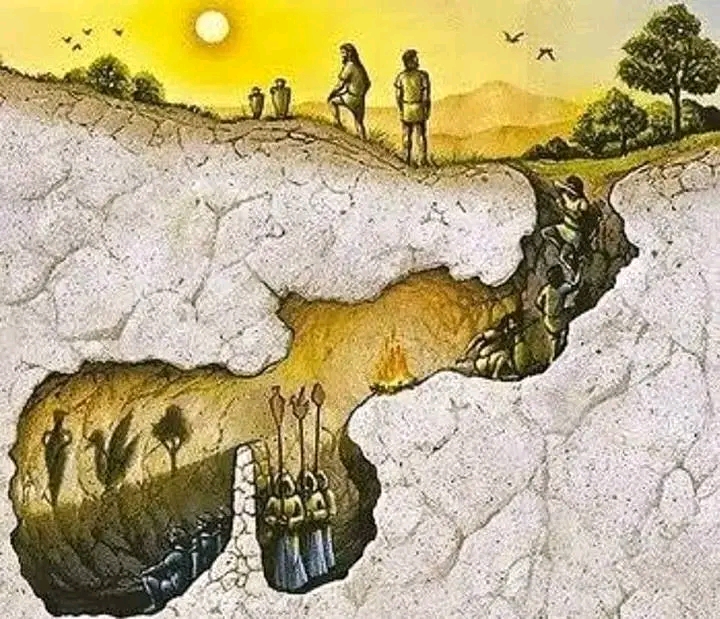
Plato’s allegory of the cave remains one of the most enduring and thought-provoking philosophical allegories in history. Through the simple yet profound narrative of individuals confined within a cave, Plato delves into the nature of reality, perception, and the pursuit of knowledge. This allegory serves as a timeless reminder of the challenges inherent in seeking and accepting truth, even in the face of resistance and ignorance.

Imagine a cave, where individuals spend their entire lives with their backs to the entrance, gazing upon a wall illuminated by a fire behind them. The only reality they know are the shadows cast upon the wall by objects passing in front of the fire. These shadows, distorted and incomplete, become the entirety of their existence – their truth.
However, one individual dares to venture beyond the confines of the cave and into the outside world. Initially blinded by the overwhelming light of truth, this individual gradually comes to understand the fallacy of the shadows. The reality outside the cave, though initially disorienting, is far more vivid and authentic than the illusory world within.
Returning to the cave, enlightened and eager to share the newfound truth with their fellow cave-dwellers, this individual is met with skepticism and hostility. The inhabitants, accustomed to the shadows and unaware of any other reality, reject the notion of a world beyond their own perception. They cling to their familiar illusions, unable or unwilling to comprehend the existence of a greater truth.
Plato masterfully uses this allegory to illustrate the plight of philosophers and truth-seekers throughout history. Just as the enlightened individual faces resistance from those entrenched in ignorance, so too do intellectuals and visionaries encounter opposition when challenging the status quo. The pursuit of truth often requires courage and perseverance in the face of societal pressures and entrenched beliefs.
In today’s world, the allegory of the cave remains as relevant as ever. In an age of misinformation and echo chambers, many are content to remain within the comfort of their own perceptions, unwilling to confront uncomfortable truths. Those who dare to challenge conventional wisdom are often met with scorn or dismissal, their voices drowned out by the cacophony of ignorance.
Yet, despite the challenges posed by the allegorical cave, there is hope. Just as the enlightened individual found liberation outside the cave, so too can humanity transcend the limitations of its own perception. It is only through courage, introspection, and a willingness to confront uncomfortable truths that true enlightenment can be achieved.
As we reflect on Plato’s allegory of the cave, let us aspire to be like the enlightened individual – brave enough to venture into the unknown, resilient enough to withstand opposition, and compassionate enough to share the light of truth with others. For it is only by embracing the truth that we can truly free ourselves from the shadows of ignorance and embark on the path to enlightenment.
 Astro
Astro 